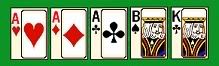
jakovasaurus wrote:David wrote:It's a set.
I recall a drive home from Waikerie after Matt and Krunchies poker day when benny the cunt became involved in a discussion about the difference between a set and trips.
Gareth - "its trips"
benny the cunt - "its not c*%$, its a set"
Gareth - "they're the same thing"
and then the fun truly began.
possibly the funnest full on argument i have had with gareth. btw, it has been going on ever since i met him. he thinks "set" is just some ghey redundant 2p2 speak, and i think it is called differently because of the different board texture that each of them have.
Nevah play JJ wrote:Sorry benny the cunt.. Don't understand.. "not even close"?
sorry, i mean that i dont think this is a tough decision, it is a clear fold.
think about what type of hands will get all in with you here.
the first is flushes. because of the action preflop, it is unlikely that someone will have two hearts that are both below a jack. as a result, if they have the flush already, the overwhelming majority of the time, you will be drawing just about dead.
the second is a set. against a set, you have around a 30% chance of winning - i.e we are assuming our heart is good in this case. even with this big assumption, we are only around 30%. not great.
the third type of hand we can come up against is an overpair. if someone has queens or kings or aces here, without any heart, then we are once again around 35% to win. if they have a heart to go along with their overpair, then we are around 10% to win. once again, the odds arent great.
the fourth type of hand we can come up against is the monster draw. these include hands like AQ or AK where they have the ace of hearts, or possibly a straight draw and a flush draw or a pair and a flush draw. a hand like AK with a single heart is actually a favourite against our hand - typically 14 or 15 outs or so (ace or king or heart, for example is 15 outs, minus the heart we have in our hand makes 14.), which is about 55%, so it is basically a coin flip.
the fifth type of hand is the lower pair, i.e tens, a single pair of nines, or possible but unlikely, 88 or 66. against these hands we will have anywhere between 65 and 90% equity.
the last type of hand is a bluff, but this will happen not very often.
as you can see, i have just written a very long winded explanation.
but in general, you can see that we are either a coin flip, or we are significantly behind in this case. the key thing to recognise here is not the absolute strength of our own hand, but the strength of our hand against what the opponents might hold.
hope that makes sense to everyone, tell me if i have made a mistake.
so as you can see, just about every type o


 . The point of my side is that spergy pedantry contributes nothing to a discussion and serves little purpose in most contexts. It's not "ghey redundant 2p2 speak" it's "ghey pedantic 2p2 speak" and seems to be used as a means of lording knowledge over people, which is just downright retarded. I think that if a persons intended meaning is clear (and I mean crystal f%cking clear here, saying "I had A7 and I flopped a set of 7s", nobody that has half a brain is going "HURRR I DON'T KNOW WHAT YOU MEAN YOU CAN'T FLOP A SET THERE HURRRR") then such fervent insistence that the person describes it in a certain way just bogs down a strategy discussion in worthless semantics. Considering that a set and trips cannot coexist on a board (the set then becomes a full house. Please let me know if there is some variant of poker wherein this is not the case, as I'd be interested to hear it) if a person uses the terms interchangably to describe